
Michael Giakoumis - Gameplan for Hamstring Strains
Jul 13, 2026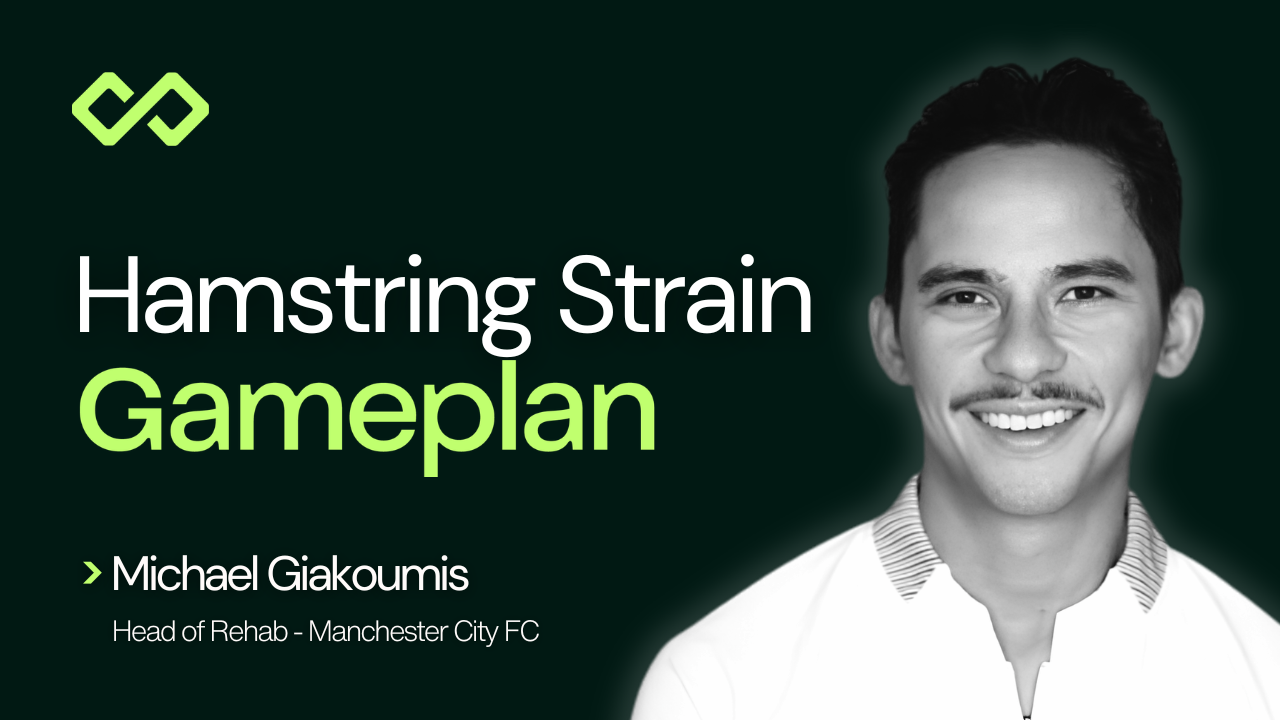
Episode 223: In this 1st episode of Gameplans — a collaboration between Gameplan and Inform Performance, Host Andy McDonald is joined by Michael Giakoumis, the Head of Rehab at Manchester City FC.
Michael is an experienced sports physiotherapist with specialised expertise in complex hip, groin, and lower-limb muscle injuries, frequently providing second opinions for challenging cases. He has previously held roles at the Marylebone Health Group in their specialist hip, groin, and muscle injury clinic, as well as within elite international athletics with British Athletics and across multiple other sports.
In this episode, Michael Giakoumis shares his comprehensive framework for hamstring rehabilitation, emphasising the importance of understanding sport demands, individual variability, and systematic planning for effective recovery.
Topics Discussed
- Deconstructing game and task demands as the foundation of hamstring rehab
- Speed banding framework for structuring return to run progressions
- Tissue-specific physical qualities and how to sequence their development
- Strength, endurance, and rate of force development criteria by speed band
- Kinetic chain benchmarks for ankle and knee alongside hamstring targets
- Injury subtype classification and its influence on return to run timing
- Criteria-informed vs criteria-led decision making in return to play
- Post-return monitoring and managing residual rehabilitation goals in-season
Key Points
-
Game and Task Demands as the Starting Point: Effective hamstring rehabilitation begins by clearly defining what the athlete must return to. This requires understanding the demands of the game at a macro level — total volumes of high-speed running, sprint distance, accelerations, and the density of peak actions within condensed timeframes. From there, the demands of specific tasks relevant to the injury mechanism are considered, followed by the individual characteristics of the athlete, including position, play style, speed profile, and anthropometry. The same injury in two athletes in the same position can require meaningfully different rehabilitation targets when these contextual layers are applied systematically.
-
Speed Banding as a Return-to-Run Framework: Return to run progressions are structured around speed boundaries — approximately 3.5, 5, 7, and 9 metres per second — that correspond to measurable increases in biomechanical demand on the hamstrings. This approach offers greater objectivity and individual fairness than time-based protocols, as a percentage of maximum velocity is not equivalent across athletes of different absolute speeds. The speed bands serve as gates that inform clinical decision-making at each transition, grounding progression decisions in the mechanical demands the tissue will actually encounter rather than arbitrary timelines or population averages.
-
Tissue-Specific Physical Qualities and Sequencing: Rehabilitation addresses several distinct physical qualities — activation, muscular endurance, force production, tensile capability (force at length), rate of force development, and coordination across the local tissue and kinetic chain. These qualities are not developed in strict sequential phases; they overlap and blend depending on the injury, the individual, and the constraints present. Injury severity and post-injury inhibition naturally constrain where to begin, with lower force, higher volume endurance work and activation often preceding heavier loading in lengthened positions. The sequencing should be driven by logic and individual response rather than rigid phase timelines.
-
Force Criteria Referenced to Speed Bands: Isometric hamstring torque targets, expressed relative to bodyweight in newton metres per kilogram, increase progressively with each speed band. At 3.5 metres per second, a demand of approximately 0.5 Nm/kg reflects the relatively low biomechanical load at that speed. This rises to around 1.0 Nm/kg at 5 m/s, 1.8 Nm/kg at 7 m/s, and 2.3 to 2.5 Nm/kg at 9 m/s. Eccentric and tensile end-stage targets sit around 2.7 Nm/kg. Expressing targets in relative terms allows fair comparison across athletes of different sizes and enables consistent application of the same framework regardless of individual morphology.
-
Endurance and Rate of Force Development Targets: Muscular endurance is assessed using single-leg hamstring bridges performed at a one-second-up, one-second-down cadence, with a minimum return-to-play standard of 30 repetitions and an ideal target of 35. Rate of force development is monitored using limb symmetry index, with the expectation of left-right symmetry increasing as speed band progression advances — near symmetry expected by 7 metres per second and full symmetry expected thereafter. Absolute normative values for RFD at specific percentages of maximal voluntary contraction remain an area where published evidence is currently insufficient to prescribe precise thresholds.
-
Kinetic Chain Benchmarks Beyond the Hamstring: Return-to-play targets extend to the ankle and knee to ensure adequate force distribution across the kinetic chain. Isometric calf testing in a straight-knee position targets approximately 3.5 times bodyweight, while isometric squat or leg press targets sit around 4 times bodyweight at the knee. Absolute values must also be interpreted in relation to each other — a large gap between ankle and knee capacity, such as 5 times bodyweight at the knee alongside 3 times bodyweight at the ankle, is considered a concern even when individual values appear strong. Balance across joints is treated as a marker of robustness and injury risk management.
-
Injury Subtype Influences Return-to-Run Timing: The British Athletics Muscle Injury Classification (BAMIC) system — categorising injuries into myofascial, intratendinous, and other subtypes — helps guide the pace of return to running. Lower-grade and myofascial injuries can typically tolerate earlier and more aggressive return to running. Distal hamstring injuries and T-junction injuries — involving the junction of the biceps femoris long and short heads — warrant a more conservative approach due to the elevated relative mechanical demand placed on that region during the stance phase of running, even at lower speeds. This anatomical specificity means the injury location, not just severity, should influence the timing of initial running progressions.
-
Criteria-Informed Rather Than Criteria-Led Decision Making: Rehabilitation criteria serve as tools to inform clinical judgement, not replace it. The competitive context, injury history, risk profile agreed with the athlete and clinical team, and the alignment around the goal of each return-to-play decision all influence how criteria are weighted. In high-stakes matches or first-time low-grade injuries with limited time, practitioners may proceed with lower-than-ideal criterion values guided by symptom response. For athletes with recurrent high-grade injuries, more criteria become genuinely non-negotiable. The distinction between what constitutes a minimum standard and what constitutes an ideal standard must be explicitly established and documented in the rehabilitation plan.
-
Planning Structure Underpins Effective Rehabilitation: Successful rehabilitation requires clarity at multiple levels of planning — defining goals, identifying strategies to achieve them, and selecting specific tactics and exercise approaches within the constraints present. Constraints such as post-surgical range limitations, game schedules, and available equipment must be embedded in the planning process from the outset. Having this structure formalised — whether in a spreadsheet or a dedicated platform — ensures that the clinical team maintains a consistent process, reduces reliance on memory and habit, and enables meaningful collaboration and reflection across the multidisciplinary team throughout the rehabilitation episode.
-
Post-Return Monitoring Aligned to Injury Aetiology: Monitoring priorities following return to full training and competition should be directly linked to what was identified as the primary contributing factors at the start of rehabilitation. Practitioners should work systematically through the highest-priority unresolved physical quality targets, moving to the next priority as each is addressed. In-season demands — particularly congested schedules with two or more matches per week — frequently constrain the volume and intensity of supplementary work that can be delivered. When this occurs, the team must make explicit decisions about which goals are deferred and which remain genuinely non-negotiable for that individual's long-term availability.
Sponsors
Gameplan Is a Rehab Management System providing Medical & Performance Departments with a centralised platform to plan, track & manage the return-to-play process inside a data rich environment. Gameplan provides one platform to connect the people, process and data during rehab.


